Masterarbeiten Strategische Gestaltung
ELAI - Embedded Learning System for Sovereign AI

How do people build competence with a technology that changes faster than training can keep up?
Artificial intelligence has arrived in around 60 % of business software (G2, 2025), yet most of it is used only on the surface (PwC, 2026), because hardly anyone has learned to use it well. ELAI, a learning system, therefore moves the building of AI competence into the AI application itself, into the moment where the work happens, questions come up, and real skill takes shape. The project was developed with the German AI provider Aleph Alpha, as a working prototype, tested with internal and external experts from the learning field and AI research. It gives employees a holistic way to build AI competence in everyday work, contextual and sustainable.
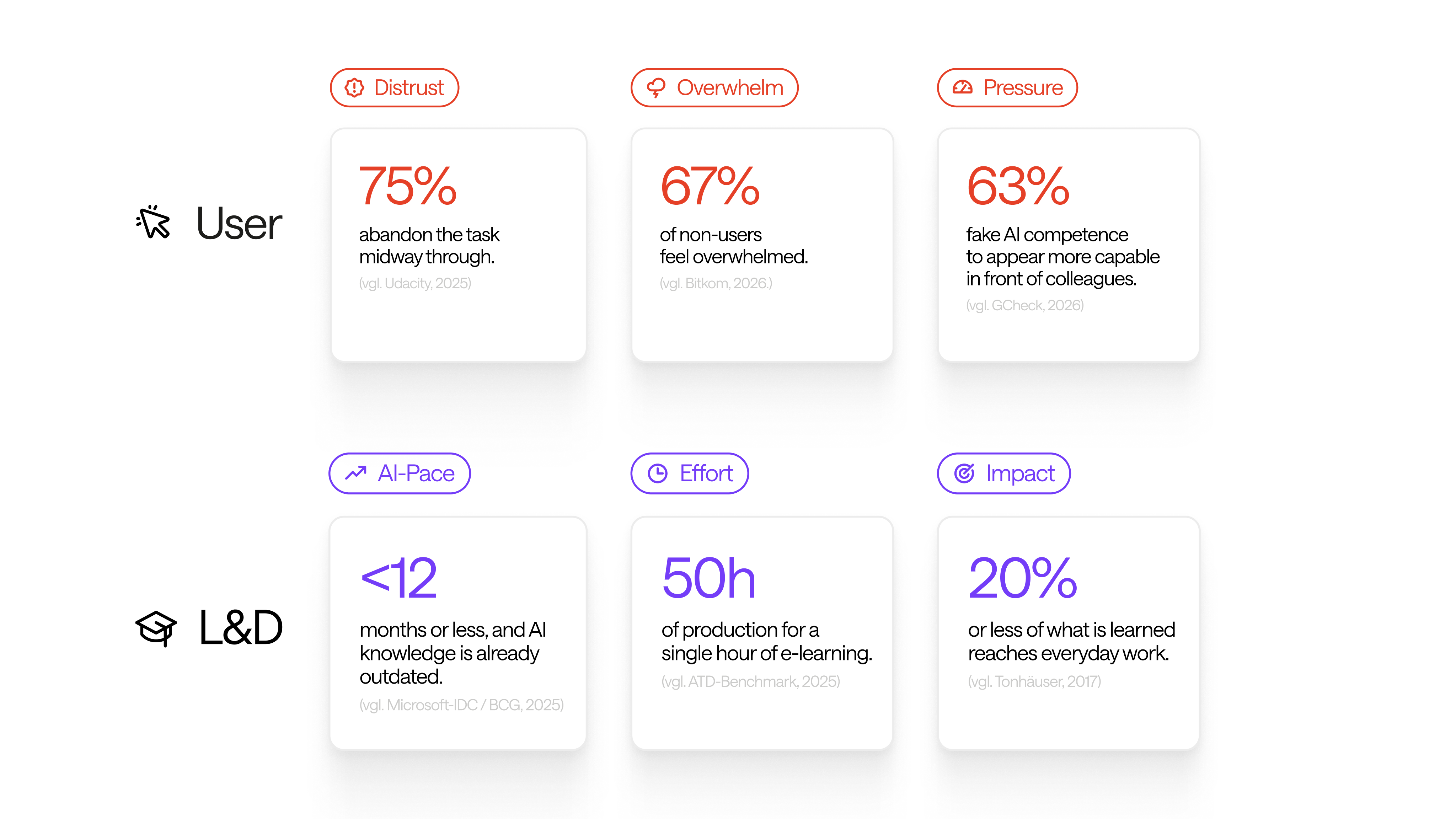
Whether in medicine, employment services, or engineering, specialized AI systems are now rolled out across almost every profession, often mandatory and under the pressure of the EU AI Act, which demands proof of competence and human oversight. Yet more than half of organizations see no ROI from it (PwC, 2026), and where competence is missing, this tips into quality and safety risks (Dell’Acqua et al., 2026; IBM, 2025). A technology is only as good as the people who work with it, which is exactly why training matters. Yet only 12 % consider their employer’s AI training effective (Microsoft, 2025), and barely a fifth of what is taught reaches practice (Tonhäuser, 2017). AI competence needs hands-on learning, right inside the applications where employees work with it every day.

The result is ELAI, an embedded learning system that lays itself as a configurable learning layer over existing enterprise AI applications. It asks users contextual questions and eases them into short learning moments. It runs on-premise, and usage data leaves the organization only in aggregated, anonymized form. The system consists of two AI agents. The Tutor Agent accompanies end users directly in the interface of their application, reactively on request and proactively with short learning prompts. The Composer Agent supports Learning & Development Teams (L&D) in analyzing the application, placing learning moments, and measuring their success over time.

For users, the Tutor Agent is set up in under 30 seconds. Three short questions are enough, and it adapts to their level. After that, the system moves into the background and speaks up only when the context and the moment fit.
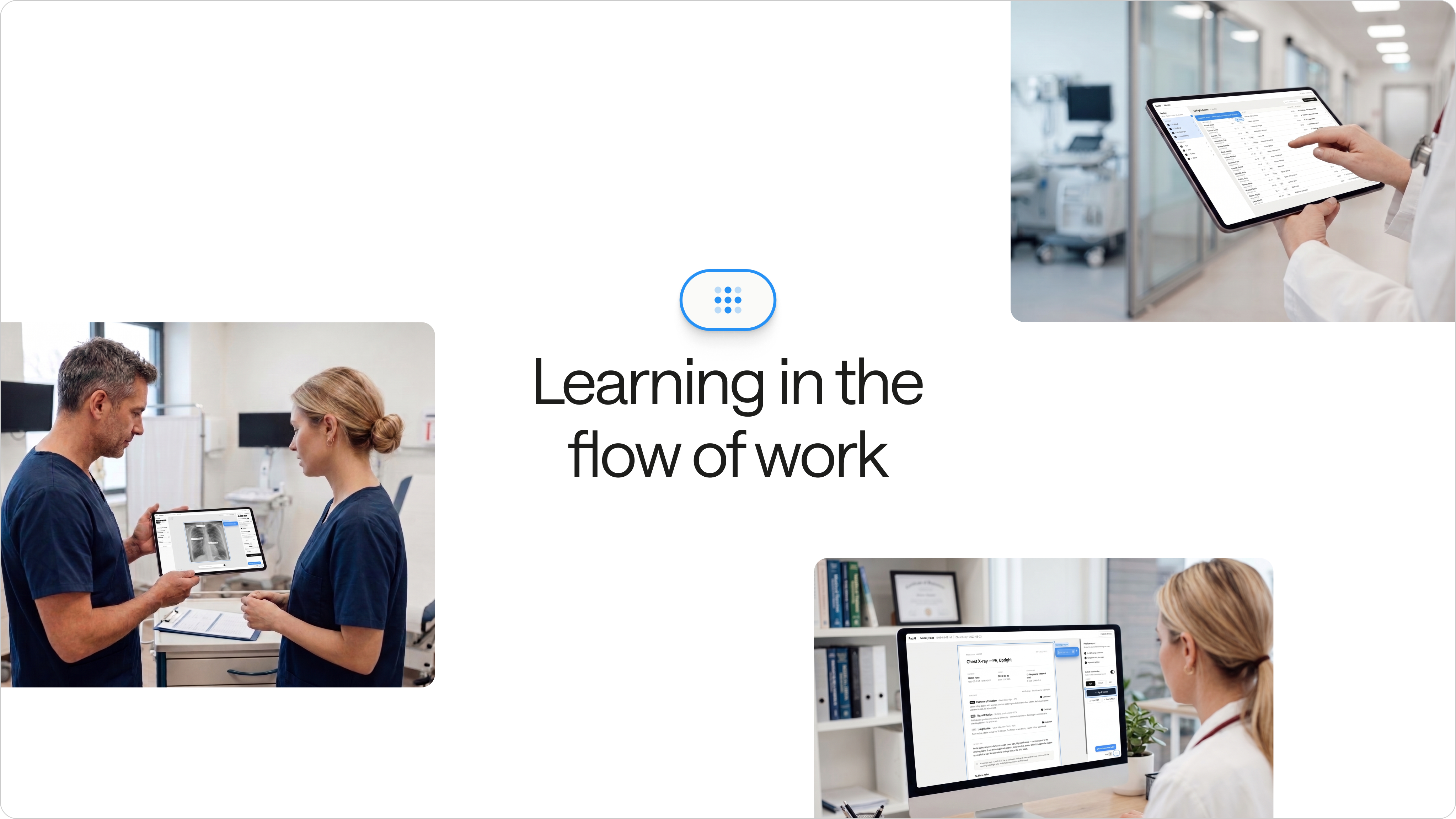
During everyday work, ELAI appears with small annotations in the interface, depending on urgency and learning context. The tutor asks questions, explains by operating the UI elements itself, and disappears again without disrupting the flow of work. Only for a clear quality or safety risk does an annotation stay until the user responds. Users can also approach the tutor themselves and show it, by marking UI elements, where they need support.

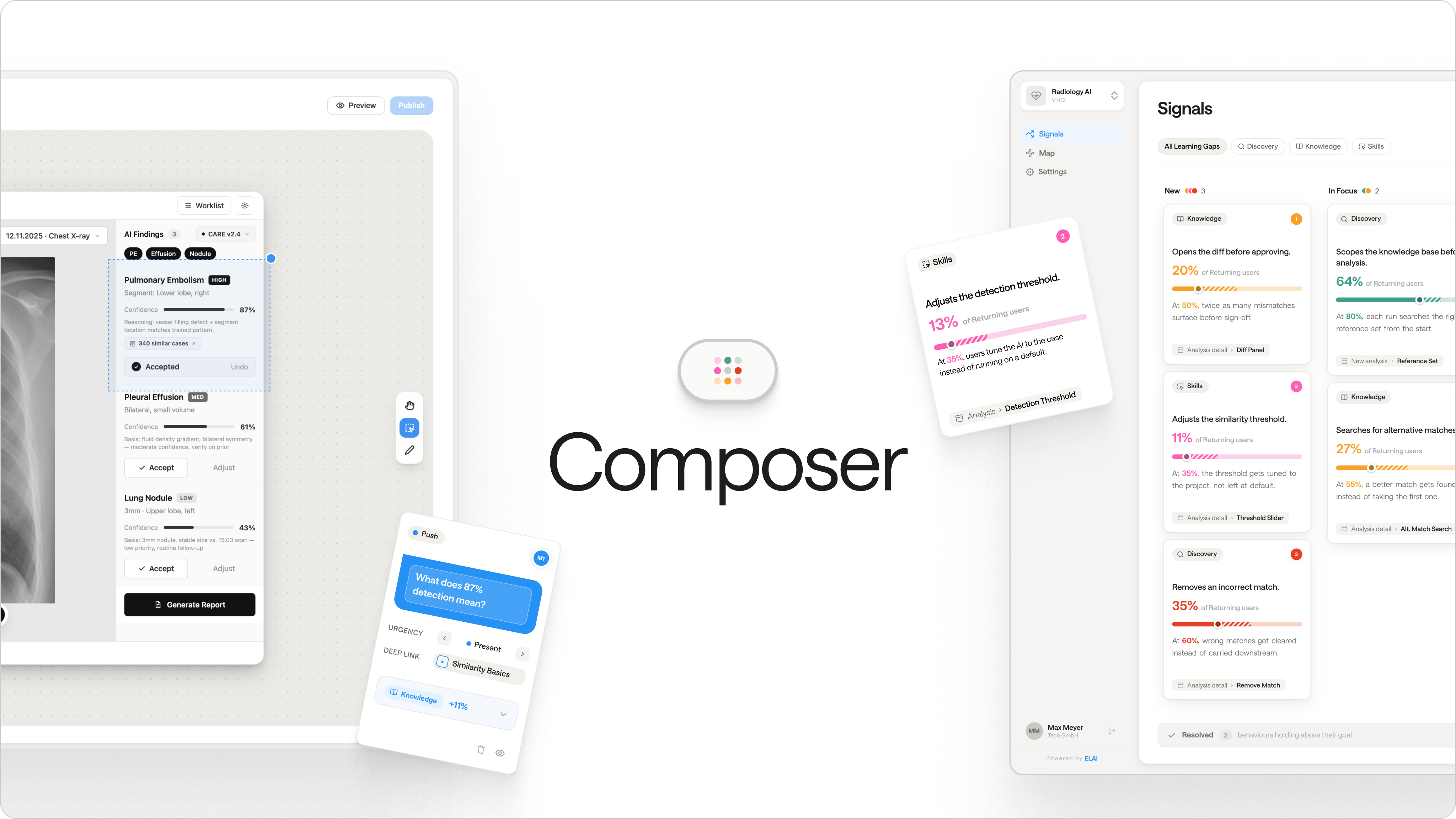
What the end user experiences as light guidance is deliberately designed elsewhere. The Composer Agent, with its own application, helps Learning & Development teams (L&D) steer, review, and evaluate the learning system.

For this, the learning system needs context, in the form of company and user data, system prompts, and above all a pedagogical foundation to teach by. In this case, the four dimensions of the AI Fluency Framework (Dakan & Feller, 2025).

On the Map, the Composer Agent analyzes every screen of the AI application and assigns its UI elements to these competencies. For each feature, this produces an Observable Behavior, a positively phrased, measurable action that a competent user would perform. When too few users show this behavior, the Composer Agent suspects a Learning Gap. It distinguishes whether users lack the knowledge (Knowledge Gap), the skill (Skills Gap), or simply awareness of the feature (Discovery Gap) (Gagné, 1985; Norman, 2013), because each case calls for a different learning experience. From this analysis come Signal Cards, and from them Learning Moments that the designer reviews, adjusts, and publishes.

Every Signal Card sits clearly in a Kanban board, movable and filterable by user level, so the learning progress of individual users can be observed and steered where needed (human-on-the-loop). Added to this are AI-specific signals such as the number of accepted push questions. They complement classic usage figures like dwell time and make the learning experience measurable as a whole.

Building AI competence calls for new learning paths that connect employees, L&D teams, and organizations, from the moment of learning to measuring its impact. ELAI uses AI itself for this and brings fitting learning experiences into everyday work, personally and at the moment of need. Pedagogical control, responsibility, and measurement stay with the L&D teams who curate the content. Because only in the interplay of AI provider, L&D team, and users can AI competence be fostered in a practical and lasting way, and with it the AI transformation of organizations truly move forward.

Dakan, R., & Feller, J. (2025). AI Fluency: Framework & Foundations [Online course]. Anthropic. https://anthropic.skilljar.com/ai-fluency-framework-foundations
Dell’Acqua, F., McFowland, E., Mollick, E. R., Lifshitz-Assaf, H., Kellogg, K., Rajendran, S., Krayer, L., Candelon, F., & Lakhani, K. R. (2026). Navigating the jagged technological frontier: Field experimental evidence of the effects of AI on knowledge worker productivity and quality. Organization Science. https://doi.org/10.1287/orsc.2025.21838
G2. (2025). G2 software marketplace [Database; own analysis of AI-integrated and AI-native B2B products]. G2. https://www.g2.com/
Gagné, R. M. (1985). The conditions of learning and theory of instruction (4th ed.). Holt, Rinehart and Winston.
IBM. (2025). Cost of a data breach report 2025. IBM Security (Ponemon Institute). https://www.ibm.com/reports/data-breach
Mager, R. F. (1962). Preparing objectives for programmed instruction. Fearon Publishers.
Microsoft. (2025). Work Trend Index 2025. https://news.microsoft.com/de-de/welche-ki-fertigkeiten-arbeitnehmende-brauchen/
Norman, D. A. (2013). The design of everyday things (Rev. & exp. ed.). Basic Books.
PwC. (2025). Global Workforce Hopes and Fears Survey 2025. PwC. https://www.pwc.de/de/pressemitteilungen/2025/deutschland-im-ki-paradox-grosses-interesse-kaum-anwendung-produktivitaetspotenzial-bleibt-ungenutzt.html
PwC. (2026). Want ROI from AI? Go for growth. PwC. https://www.pwc.com/gx/en/issues/technology/ai-performance/want-ai-roi-go-for-growth.html
Tonhäuser, C. (2017). Wirksamkeit und Einflussfaktoren auf den Lerntransfer in der formalisierten betrieblich-beruflichen Weiterbildung [Effectiveness and factors influencing learning transfer in formalized company-based vocational training]. bwp@ Berufs- und Wirtschaftspädagogik – online, 32, 1–21. https://www.bwpat.de/ausgabe/32/tonhaeuser